

How do investors use forward‑looking impact data to steer capital toward climate technologies?
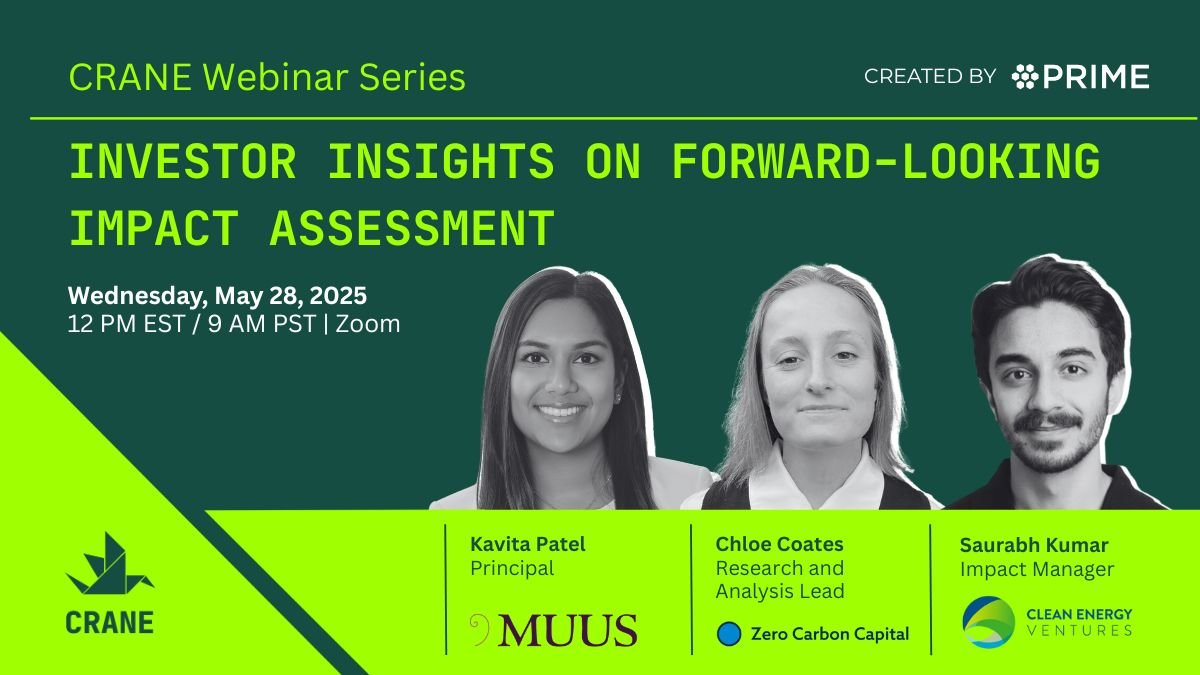
The latest webinar featured three CRANE power users—Kavita Patel (Principal at MUUS Climate Partners), Chloe Coates (Research and Analysis Lead at Zero Carbon Capital), and Saurabh Kumar (Impact Manager at Clean Energy Ventures)—who shared how they use GHG impact modeling to assess early-stage climate technologies.
While their approaches vary, the key message was clear: forward-looking impact models are less about certainty and more about making better-informed decisions. The blog below distills key insights from the discussion.
Disclaimer: CRANE's content should not be considered financial advice. Our work is intended for users to review and use their best judgement to accelerate GHG mitigation with transparency and accountability.Approaches to Impact Assessment
All three panelists rely on potential impact assessments to steer early-stage climate-tech investments, but they diverge on thresholds, timelines, and portfolio goals.
The initial “back-of-the-envelope check” lets Coates verify that a technology satisfies Zero Carbon’s thesis and its bar of cutting 0.5 gigatons of CO₂e annually by 2050. This top-down assessment suits early-stage startups that commonly lack a business model, with the key assumption that “the tech [with the most GHG impact] takes a sizable share of the market.”
Kumar incorporates impact measurement early in the diligence process, explaining, “We do a market-share-adjusted potential impact… taking the overall opportunity, applying an S curve to it, and trying to understand what will happen on a technology-level basis.” Planned impact is also assessed post-investment, supported by real-world forecasts post-commercialization.
Patel places a stronger emphasis on timeframes and portfolio-level results. MUUS aims for an average reduction of 150 megatons of CO₂e per company across its portfolio. “We use a 10-year horizon to align with our fund life—and to weight near-term impact more heavily,” Patel says.
Balancing Timing With Impact Magnitude
Choosing between timing and magnitude is a central challenge in climate investing: should capital flow to technologies that deliver modest, immediate cuts, or toward bigger breakthroughs that take longer to mature?
Patel tackles this dilemma with portfolio-level targets. MUUS, for example, recently backed a Waze-like software that supports fuel efficiency. It was attractive due to rapid deployment, scarce competition, and easily measured fuel savings, delivering an immediate emissions reduction even if the cumulative impact is smaller.
Throught the time-value-of-carbon lens, Coates also weights near-term impact more heavily while accounting for accelerating effects of enabling technologies. “If you can bring that S-curve forward, you’re changing the cumulative emissions profile. That’s a big deal,” she notes, while acknowledging the uncertainty embedded in their assumptions.
Kumar adds a climate impact taxonomy and scenario modeling to his analysis. In comparison with solutions that directly cut emissions, enabling technologies are also viewed as having a higher likelihood of delivering measurable impact.
Relevant CRANE Features
Uncertainty Parameter: Edit uncertainty values in Solution Unit Emissions and Serviceable Obtainable Market (SOM) pages to bound your results, which will be reflected in the CRANE impact report as Lower, Mid, and Higher ranges.
References: Click the "References" button in the top-right corner to review or edit your referenced sources, which will automatically include them in your final CRANE impact report.
Precision vs. Practicality
Assessing forward-looking impact is less about predicting the future with certainty and more about distilling the best available data into decision-useful analysis.
“The purpose is to make investments and try and steer capital towards the best climate solutions. (...) It’s not to have a perfect, academic literature-level assessment,” Coates said. She advises teams to “state your assumptions, reference your data sources, and be as transparent as possible,” while using accessible frameworks like Project Frame and CRANE to guide the process.
Kumar treats impact modelling as an iterative process, where different levels of detail are applied at different stages, with regularly updated and transparent model assumptions. “I don’t want to feel scared to walk an LP through this,” He noted. “I want to feel like I’m about to show them something they’re going to find very interesting.”
Patel added that their team categorizes each model’s fit—high, medium, or low—based on available data, distinguishing between enabler and direct impact pathways. Tracking these changes, while keeping assumptions transparent as companies evolve, has been essential for strong LP communication.
"Use your impact story as a tool to help you in gathering resources. It drives performance in hiring, in fundraising, and with customers. It is part of the core value proposition in a lot of cases for these technologies.”
- Kavita Patel, MUUS Climate Partners
Final Thoughts
The panelists ended with some key takeaways for those new to impact measurement. First, anchor every model in its purpose: “ask yourself what you’re modeling for,” and judge success by the decisions it informs, not perfect precision. The CRANE tool can be a useful starting point with its ready-to-use templates and impact data. Second, “lean into the estimates,” but support them with solid unit economics and a clear case study. Finally, “the story piece is more important than the exact estimate.” Begin with a robust theory of change that links innovation to real emissions reduction, and refine the model as more data becomes available.